Full game metadata
| Field | Value |
|---|---|
| Steam app type | game |
| Steam App ID | 355750 |
| Live current players | 0 |
| SteamPulse tracked peak | 0 |
| Live count (today's peak floor) | 0 |
| Price | No longer available on Steam Store |
| Free to play | No current Steam offer |
| Discount | Not available |
| Original price USD | Not available |
| Current price USD | Not available |
| Release date | Coming soon |
| Developer | mtb design works, inc. |
| Publisher | mtb design works, inc. |
| Owners estimated | Not available |
| SteamSpy owner estimate minimum | 0 |
| SteamSpy owner estimate maximum | 20,000 |
| Review type | No user reviews |
| Positive review percent | Not available |
| Positive reviews | 0 |
| Negative reviews | 0 |
| Total reviews | 0 |
| Steam recommendations | Not available |
| Achievements | Not available |
| Average playtime forever | Not available |
| Windows support | Yes |
| macOS support | No |
| Linux support | No |
| Parent game | Not available |
| Store URL | Not available on Steam Store |
Short description
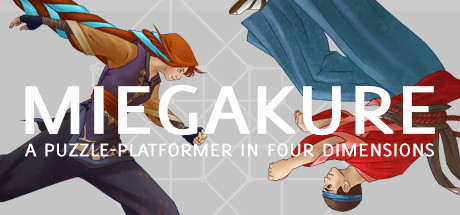
Miegakure is a game where you navigate a four-dimensional world to perform miraculous feats and solve puzzles.
About this game
Miegakure is a puzzle/adventure game, the first that lets you explore and interact with a 4D world. In this game, the fourth dimension is not time! It is an actual fourth dimension of space, that works just like the first three dimensions we are familiar with. If you count time, this game is 5D. For a while games used to be 2D, taking place solely along two directions. For example, a game character could only move forwards and backwards, or jump up and down. Then came computers powerful enough to render 3D graphics, which allowed for full 3D movement: up / down, backwards / forwards and left / right. (Of course, the graphics we see, while they are computed in 3D, are displayed on a 2D screen. They are projected down from 3D to 2D, in a way that mimics how our eyes perceive the third dimension.) But it doesn’t stop there. If in a 2D game every object’s position is represented in the computer using two numbers, and if in a 3D game every object’s position is represented using three numbers, what if each position was represented using four numbers? In other words, what if there was another direction you could move along in addition to the first three? Trying to answer this question is what that led us to develop this game. As far as we know, our universe has exactly three spatial dimensions — so it’s difficult for us to picture what a four-dimensional world would look like. But a computer, on the other hand, does not care; it’s just working with numbers as usual (it’s just slightly more numbers in this case!). So we had to come up with a way to display this calculated 4D world so that our three-dimensional brains could comprehend it. The way we chose is a method that has been popularized in the novella Flatland. This novella talks about a 2D square that can only see a 2D cross section of a 3D world. For the square, the third dimension is invisible and mysterious; the square has no concept of it because it is stuck seeing a 2D world. If a 3D object visits the 2D plane it appears to be deforming, in a way that looks like an M.R.I. scan (of a brain, for example). In an M.R.I. what we see while moving the slice through the object appears to be deforming, but we know th…
Supported languages
English, French, Italian, German, Spanish - Spain